Agency News
August 31, 2026 · 10 min read
A stroke can change daily life in an instant. After the hospital stay, families often face new questions about medications, mobility, safety, appointments, and emotional recovery.
The transition home matters.
For seniors in Waukesha, Milwaukee, Racine, Jefferson, Ozaukee, and Washington counties, RN-led skilled home health can bring clinical guidance and compassionate support into the place where recovery continues: home.
Abia Home Health LLC provides physician-coordinated skilled nursing and home health aide support throughout Southeast Wisconsin. Our local nurses take a personal, unhurried approach. They help patients rebuild confidence while helping families understand what comes next.
Home health begins with a clear plan developed around the patient’s needs, physician’s orders, and home environment.
Abia’s registered nurses coordinate directly with physicians, hospital discharge teams, therapists, specialists, and family members. This helps connect the hospital plan with the realities of everyday life at home.
Your care team may focus on:
The goal is not to rush recovery. The goal is to make each step safer, clearer, and more manageable.
Stroke recovery can involve changes in strength, balance, speech, swallowing, memory, mood, and coordination. A skilled nurse observes these changes during home visits and communicates concerns to the appropriate healthcare provider.
This skilled observation provides an important connection between appointments. Your nurse may monitor vital signs, review symptoms, assess how the patient is managing at home, and identify concerns that deserve medical attention.
Families should not have to wonder whether a change is important. The nurse can help explain what to watch for and when to contact the physician.
Home health does not replace emergency care. If a patient develops sudden facial drooping, arm weakness, speech difficulty, severe headache, sudden confusion, or another possible stroke symptom, call 911 immediately.
Medication routines can become more complicated after a stroke. A patient may return home with new prescriptions for blood pressure, cholesterol, blood-thinning, seizure prevention, or other health needs.
Your nurse can help by:
Medication teaching is not simply handing someone a list. Stroke-related memory, vision, weakness, or communication changes may make the routine harder to manage. A nurse can slow down, repeat instructions, and involve the caregiver in a practical way.
The American Stroke Association’s guidance on living at home after stroke also emphasizes the importance of following medical advice and taking medications as prescribed.

Many seniors experience weakness, balance problems, fatigue, or changes on one side of the body after a stroke. These challenges can make standing, walking, bathing, and transferring more difficult.
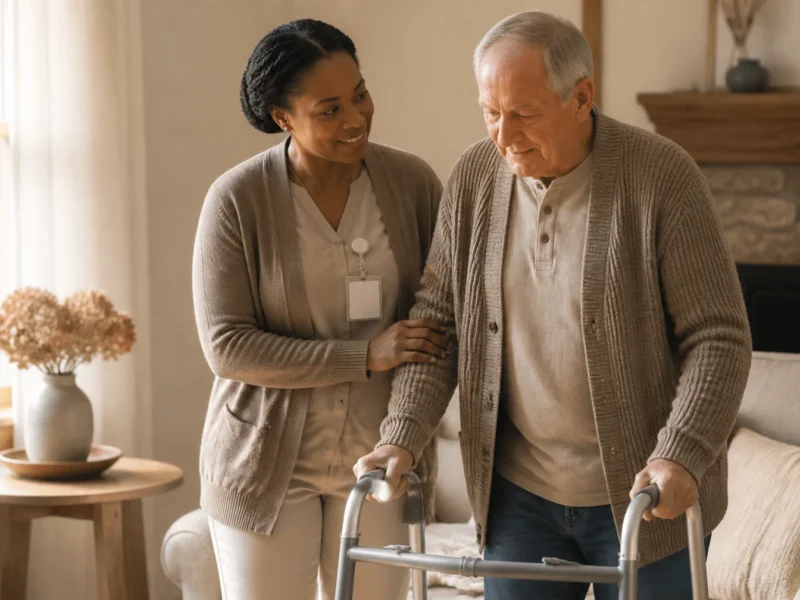
Your nurse can assess everyday risks and reinforce the mobility recommendations provided by the physician and therapy team. This may include reviewing how the patient uses a walker or cane, how transfers are completed, and whether the home setup creates unnecessary hazards.
Helpful safety steps may include:
Abia’s skilled nursing services include fall prevention assessment. Our team can also communicate with therapists so that safety strategies remain consistent across visits and appointments.
Small changes can protect independence. A clear walking path may allow a patient to move more confidently. A better-organized bathroom may reduce fear and dependence.
Family members often become an important part of stroke recovery. They may help with medications, meals, bathing, transportation, exercises, appointments, and emotional support.
But caregivers need education, too.
Your nurse can demonstrate safer ways to assist with mobility and personal care. The nurse can explain what changes to report, reinforce therapy instructions, and help families create routines that fit the patient’s abilities.
Caregiver education may address:
The right amount of help can be difficult to judge. Doing everything for a loved one may unintentionally reduce opportunities to practice. Expecting too much too soon may create frustration or risk.
A nurse can help families find a safer middle ground: support when needed, encouragement when possible, and patience throughout the process.
Physical, occupational, and speech therapists may play central roles in stroke recovery. Physical therapy can address walking, strength, and balance. Occupational therapy can focus on daily activities such as dressing, bathing, and meal preparation. Speech therapy may support communication, memory, and swallowing needs.
The home health nurse does not replace these therapists. Instead, the nurse helps connect the plan.
Your nurse may ask how therapy is progressing, observe how recommendations work in the home, and communicate relevant changes to physicians or therapists. This coordination can help the entire team understand what the patient is experiencing between sessions.
The Wisconsin Coverdell Stroke Program highlights the importance of connected stroke systems of care across Wisconsin. Consistent communication helps patients and families avoid feeling caught between separate providers.
Recovery is physical. It is also emotional.
A stroke survivor may feel discouraged by slower movement, difficulty speaking, dependence on others, or uncertainty about the future. A family member may feel worried, tired, or unsure how to help.
Your nurse offers more than clinical tasks. A calm visit can give the patient time to ask questions, practice a skill, and recognize progress that may otherwise go unnoticed.
Progress may look like:
A personal, unhurried approach helps recovery feel less like a checklist and more like a partnership.

Some patients need help with bathing, grooming, dressing, mobility, transfers, or light meal preparation while they receive skilled nursing.
Abia’s home health aide services are available only to patients who are currently receiving skilled nursing under an RN-developed, physician-ordered plan of care. Home health aide support is not a stand-alone personal care service.
Under the direct supervision of an Abia RN, a home health aide may provide:
This structure keeps personal care connected to the patient’s clinical plan. It also gives families a clear point of contact when needs change.
The first days after discharge can feel overwhelming. Abia helps make the hospital-to-home transition more organized.
We offer same-day admission response during business hours, based on referral details, clinical needs, physician orders, and service availability. After-hours coordination is available for urgent needs.
For hospital discharge planners and healthcare providers, Abia can help with:
For families searching for skilled nursing waukesha, home health in Milwaukee, or stroke recovery support across Southeast Wisconsin, Abia provides RN-led care close to home.
Abia Home Health was founded by Vanessa Meyer, BSN, RN, CMSRN, a Wisconsin-licensed registered nurse who saw how difficult the transition from hospital to home could be for patients and families.
Her approach is simple: care should be clinically skilled, personally attentive, and coordinated with the people who know the patient best.
Abia serves Waukesha, Milwaukee, Racine, Jefferson, Ozaukee, and Washington counties. Learn more about our skilled nursing, home health aide, and care coordination services, or read about our RN-led, family-rooted approach.
Healthcare professionals can refer a patient. Families can contact Abia Home Health to learn whether skilled home health may be appropriate.
For privacy and safety, do not include patient information in the general contact form. Secure referrals should be sent by fax to 414-413-2009 or by email to referrals@abiahomehealth.com.
Stroke recovery takes time. With the right support, home can become more than the place a patient returns to. It can become the place where confidence, safety, and independence begin to grow again.